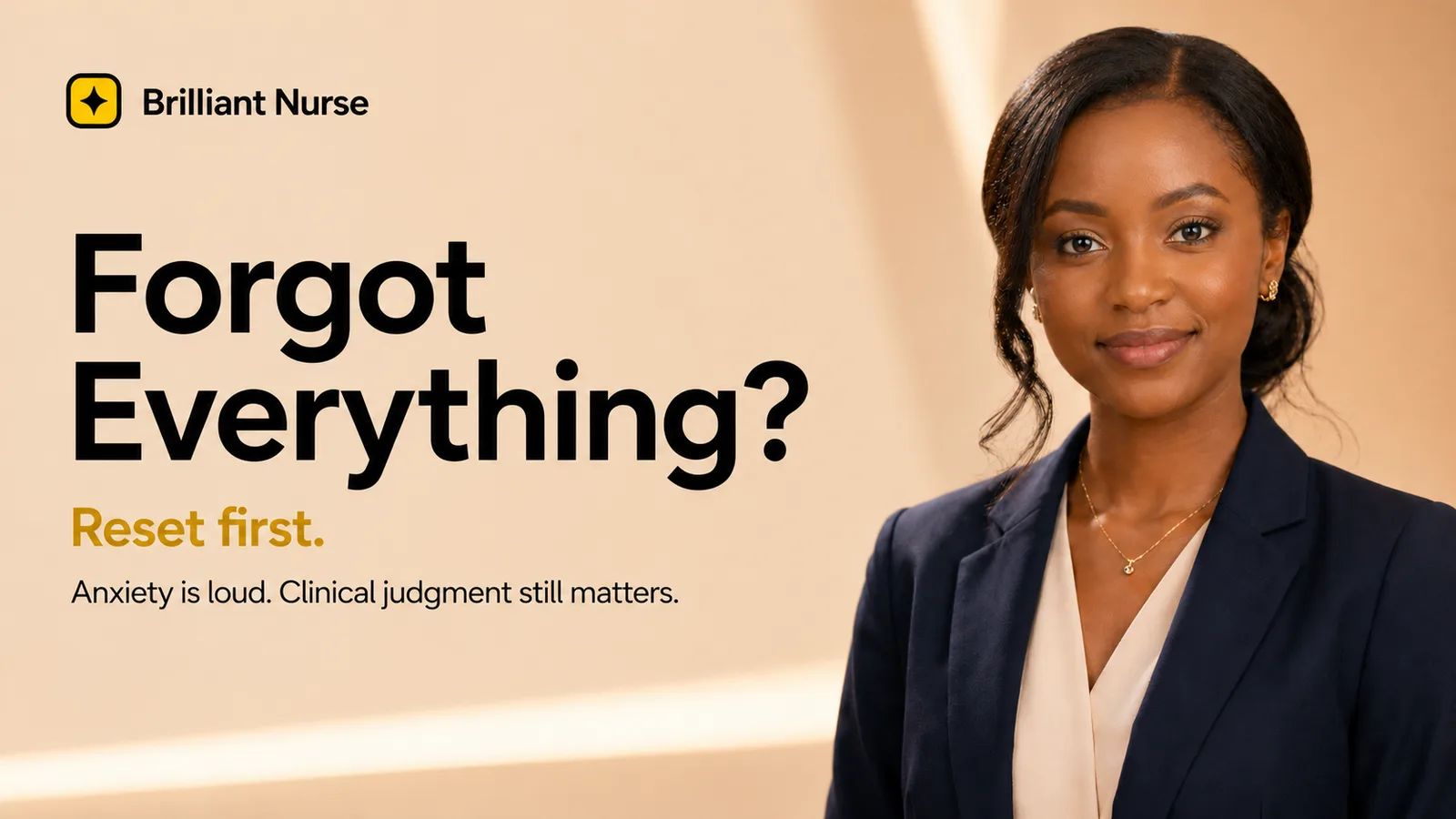
Feeling like you are forgetting everything before the NCLEX is common, especially in the final days before the exam.
It does not automatically mean you are unprepared. Anxiety can make familiar information feel unavailable, especially when you are tired, overwhelmed, or trying to review too much at once.
The simplest answer is this:
If you feel like you are forgetting everything before NCLEX, stop trying to relearn all of nursing school. Return to structure: review high-yield safety concepts, practice a small set of questions, review missed patterns, use NGN case studies carefully, protect sleep, and remind yourself that NCLEX tests safe clinical judgment — not perfect memory.
You do not need to remember everything at once.
You need to think through one patient scenario at a time.
First: This Feeling Is Common
Many students feel this right before NCLEX:
- “I forgot everything.”
- “My brain is blank.”
- “I knew this last week.”
- “Every topic feels unfamiliar.”
- “I can’t remember labs.”
- “I’m scared I’ll freeze.”
- “I feel like I studied for nothing.”
- “I should move my exam.”
That feeling can be scary.
But it is also common before high-stakes exams.
When your brain is under stress, it may scan for everything you do not know. That can make your preparation feel weaker than it actually is.
The question is not:
“Do I feel like I remember everything?”
The better question is:
“Can I use my process when a question is in front of me?”
Forgetting Everything vs. Feeling Overloaded
There is a difference between true readiness problems and anxiety overload.
| What it may be | What it sounds like |
|---|---|
| Anxiety overload | “I feel blank, but when I slow down, I can reason through questions.” |
| Fatigue | “I studied for hours and now even easy things feel hard.” |
| Panic from too many resources | “Every video reminds me of something I don’t know.” |
| Weak review method | “I do questions but keep missing the same patterns.” |
| True readiness concern | “I am guessing on most questions and cannot explain rationales.” |
Your response depends on which one is happening.
Do not treat anxiety overload like a content emergency.
Why This Happens Before NCLEX
This feeling can happen because:
- You are studying too many topics at once.
- You are switching resources.
- You are sleeping less.
- You are taking every practice score personally.
- You are panic-scrolling NCLEX stories.
- You are trying to memorize instead of reason.
- You are reviewing content without applying it.
- You are avoiding NGN case studies.
- You are comparing yourself to other students.
- You are close to test day and pressure is rising.
Your brain may not be empty.
It may be overloaded.
What to Do First: Stop the Spiral
When you feel like you are forgetting everything, do not immediately open five resources.
Do this first:
- Stop studying for 10 minutes.
- Breathe slowly.
- Drink water.
- Write down what triggered the panic.
- Choose one small task.
- Do a short practice set or review one missed-pattern list.
- Do not restart your entire study plan.
The goal is to interrupt the panic loop.
You need clarity before more content.
The 30-Minute Reset Plan
Use this when you feel blank.
| Time | What to do |
|---|---|
| 5 minutes | Breathe, drink water, step away from the screen |
| 10 minutes | Review your top missed patterns or high-yield safety notes |
| 10 minutes | Do 5–10 calm practice questions |
| 5 minutes | Review rationales and write one next step |
This is not meant to solve all NCLEX preparation.
It is meant to prove that your brain can return to structure.
The 2-Hour Reset Plan
Use this if you have more time and need a focused study block.
| Time | Task |
|---|---|
| 10 minutes | Review top missed patterns |
| 30 minutes | Targeted questions in one weak area |
| 40 minutes | Rationale review |
| 30 minutes | One NGN case study or mixed mini-block |
| 10 minutes | Write tomorrow’s focus and stop |
Do not turn the reset into a 10-hour panic session.
The purpose is recovery and direction.
What Not to Do When You Feel Like You Forgot Everything
Avoid:
- Starting a brand-new QBank
- Watching random videos for hours
- Asking strangers online if you are ready
- Reading NCLEX failure stories
- Taking a full practice exam in panic
- Trying to memorize every lab in one night
- Rewriting all your notes
- Studying until 2 AM
- Comparing your scores to classmates
- Deciding you failed before taking the exam
These actions usually make the feeling worse.
They add noise when you need structure.
Return to the NCLEX Thinking Process
When memory feels shaky, return to clinical judgment.
Ask:
- What is the question asking?
- What cue matters most?
- What does the cue mean?
- Is the patient stable or unstable?
- What is the safety risk?
- What should the nurse do first?
- What answer is safe and within the nurse’s role?
- What outcome shows improvement?
The NCLEX is not asking you to recite every fact.
It is asking whether you can make safe decisions.
Focus on Safety, Not Perfection
If you feel overwhelmed, focus on high-yield safety thinking:
- Airway, breathing, circulation
- Unstable before stable
- Acute before chronic
- New or worsening before expected
- Safety before comfort when urgent
- Assessment before intervention when appropriate
- Do not delegate assessment, teaching, evaluation, or unstable patients
- Look for abnormal labs tied to danger
- Look for medication safety risks
- Look for patient deterioration cues
Safety gives your brain a path when memory feels messy.
Review Your Missed Patterns, Not Every Topic
A common mistake is trying to review everything when panic hits.
Instead, review your personal missed patterns.
Examples:
- “I miss low oxygen saturation cues.”
- “I choose teaching before stabilizing.”
- “I overselect SATA options.”
- “I miss potassium and cardiac risk.”
- “I delegate assessment.”
- “I ignore changes from baseline.”
- “I panic during NGN case studies.”
Your missed patterns matter more than random topic lists.
They show what your brain needs to remember on test day.
Use Small Practice Sets to Rebuild Confidence
If you feel blank, do not start with 100 questions.
Start with a small set.
Try:
- 5–10 calm questions
- 10–15 priority questions
- 10 medication safety questions
- 10 lab questions
- One short NGN case study
- A few missed questions from your notes
Then review slowly.
The goal is not to prove everything.
The goal is to restart the thinking process.
Do Not Judge Yourself From One Bad Practice Set
A bad score close to test day can feel personal.
But one practice set is not your whole readiness picture.
Ask:
- Was I tired?
- Was I anxious?
- Was it a weak-area block?
- Did I rush?
- Did I review rationales?
- Did it reveal a fixable pattern?
- Is this score part of a trend?
One bad block is data.
It is not a prophecy.
What If You Suddenly Forget Labs?
Do not try to memorize every lab value in a panic.
Review labs as safety cues.
Ask:
- Does potassium create cardiac risk?
- Does glucose create safety or neurologic risk?
- Does sodium affect neurologic status?
- Does hemoglobin connect to bleeding or oxygenation?
- Do platelets connect to bleeding risk?
- Does WBC connect to infection or immune suppression?
- Does creatinine connect to kidney function and medication safety?
- Do coagulation labs connect to anticoagulant risk?
The NCLEX often tests what the lab means for nursing action.
Focus on the danger behind the number.
What If You Suddenly Forget Pharmacology?
Do not try to memorize every medication the night before.
Return to medication safety.
Ask:
- What is the drug class?
- What vital sign matters?
- What lab matters?
- What adverse effect is dangerous?
- What teaching prevents harm?
- What finding means hold the medication?
- What finding should be reported?
High-yield medication categories include:
- Insulin
- Anticoagulants
- Opioids
- Digoxin
- Lithium
- Diuretics
- Antihypertensives
- Antibiotics
- Seizure medications
- Psych medications
You do not need to know every detail.
You need to recognize safety risks.
What If You Suddenly Forget Maternity?
Focus on danger signs.
Review:
- Severe headache
- Visual changes
- Right upper quadrant pain
- Severe hypertension
- Heavy bleeding
- Boggy uterus
- Foul-smelling lochia
- Fever
- Decreased fetal movement
- Abnormal fetal heart rate
- Signs of magnesium toxicity
- Seizure risk
- Hemorrhage risk
Do not try to relearn the whole maternity course in panic.
Focus on what requires follow-up and what can harm the patient.
What If You Suddenly Forget Pediatrics?
Focus on age-specific safety and deterioration.
Review:
- Respiratory distress
- Retractions
- Nasal flaring
- Poor feeding
- Lethargy
- Dehydration signs
- Decreased urine output
- Fever in young infants
- Weight-based medication safety
- Developmental safety
- Parent teaching
- Immunization and infection risk
- Abuse or neglect red flags
Pediatrics often tests safety, development, hydration, respiratory status, and caregiver teaching.
What If You Suddenly Forget Prioritization?
Return to the basics.
Ask:
- Who is unstable?
- What is new?
- What is worsening?
- What threatens airway, breathing, circulation, neurologic status, or safety?
- Which problem can harm the patient fastest?
- Which action should happen first?
- Which answer delays urgent care?
Priority questions are not about doing everything.
They are about doing the right thing first.
What If You Suddenly Forget Delegation?
Remember what the RN keeps.
The RN generally keeps:
- Initial assessment
- Teaching
- Evaluation
- Clinical judgment
- Care planning
- Unstable patients
- Complex or unpredictable situations
- Discharge teaching
- Tasks requiring interpretation
UAPs can often help with routine, stable, predictable tasks.
If a task requires assessment, teaching, evaluation, or judgment, be careful about delegating it.
What If NGN Case Studies Make Your Brain Go Blank?
Use a case-study routine.
- Read the question task first.
- Scan for abnormal, new, worsening, or safety-related cues.
- Compare current findings to baseline.
- Decide what the cues mean.
- Identify the priority.
- Choose the safest action.
- Evaluate whether the patient improved or worsened.
Do not read the whole chart with no plan.
Read it like a nurse looking for what matters.
What If SATA Makes You Feel Like You Know Nothing?
SATA can make students overthink.
Use this method:
- Treat each option as true or false.
- Make sure each option answers the stem.
- Do not select options just because they are true in general.
- Do not add extra answers from fear.
- Do not remove correct answers from panic.
- Use the patient cue.
SATA is not about guessing the number of correct answers.
It is about judging each option independently.
What If You Keep Changing Answers?
If you are changing answers because you feel unsure, stop and use a rule.
Change an answer only if you find a clear reason:
- You misread the stem.
- You missed “first,” “priority,” “immediate,” or “follow-up.”
- You missed an abnormal lab or vital sign.
- You realized the patient is unstable.
- You selected something outside the nurse’s role.
- You missed a contraindication.
- You misunderstood the question task.
No clear reason?
Do not change it just because anxiety got louder.
What If You Feel Worse After Studying?
That may mean you are overloaded.
Try:
- Shorter blocks
- More breaks
- Fewer resources
- More rationale review
- Less passive video watching
- One weak area at a time
- No social media after practice blocks
- Earlier bedtime
- A readiness check instead of random studying
If every study session makes you feel worse, the schedule may need to change.
When This Feeling Means You Need Rest
Sometimes the best study move is rest.
You may need rest if:
- Easy questions feel impossible.
- You keep rereading the same sentence.
- You cannot absorb rationales.
- You are crying from exhaustion.
- You are studying late every night.
- You are making careless mistakes.
- You are forgetting things you normally know.
- You feel numb or frantic.
Rest is not quitting.
Rest protects the brain you need for test day.
When This Feeling Means You Need a Readiness Check
If you cannot tell whether the feeling is anxiety or a real readiness problem, take a structured readiness check.
Then look at:
- Mixed question performance
- NGN case-study performance
- Rationale understanding
- Repeated mistake patterns
- Safety and priority performance
- Medication/lab safety
- Timed-block stamina
Do not rely only on feelings.
Use evidence.
When This Feeling Means You Should Consider Rescheduling
Do not reschedule just because you feel scared.
But consider rescheduling if readiness evidence is consistently weak and official rules still allow it.
Warning signs include:
- You are guessing on most questions.
- Your scores are consistently very low.
- You have not practiced NGN case studies.
- You do not understand rationales after review.
- You are unsafe with priority, delegation, meds, labs, or safety.
- Anxiety or illness prevents you from functioning.
- You cannot complete practice blocks.
- You still have time to reschedule under official rules.
Use evidence, not panic.
The Final-Week “I Forgot Everything” Plan
If your NCLEX is in one week, use this plan:
| Day | Focus |
|---|---|
| Day 1 | Readiness check and missed-pattern review |
| Day 2 | Priority, delegation, infection control |
| Day 3 | Pharmacology safety and labs |
| Day 4 | Patient deterioration and emergencies |
| Day 5 | NGN case studies and cue recognition |
| Day 6 | Mixed practice and final weak-area repair |
| Day 7 | Light review, logistics, rest |
Do not use the final week to relearn everything.
Use it to stabilize what matters most.
The Day-Before “I Forgot Everything” Plan
If your NCLEX is tomorrow:
Do:
- Light review
- Missed-pattern notes
- Priority frameworks
- Infection precautions
- Medication/lab danger cues
- Test-day logistics
- ID check
- Clothing and food preparation
- Sleep
Do not:
- Take a full practice exam
- Start a new resource
- Watch hours of videos
- Study all night
- Ask strangers if you are ready
- Panic-scroll failure stories
The day before NCLEX is about protecting your ability to think.
What to Tell Yourself When You Feel Blank
Use short phrases:
- I do not need to know everything at once.
- I only need to answer this question.
- Find the cue.
- Think safety.
- Stable or unstable?
- What changed?
- What should the nurse do first?
- Hard does not mean failing.
- Anxiety is loud, but I can still think.
- My process matters more than panic.
Simple phrases work better than long pep talks.
The Parking-Lot Script
Before walking into the test center, say:
“I do not need perfect memory. I need safe nursing judgment. One question at a time. Find the cue. Think safety. Choose the best answer and move on.”
Do not sit in the car trying to memorize random facts.
Walk in with a process.
The During-Exam Script
If your mind goes blank during the exam, say:
“Pause. Breathe. Read the stem. Find the cue. Think safety.”
Then continue.
Your brain does not need to feel calm to work.
It needs a path.
The Real Confidence You Need
Real NCLEX confidence does not mean:
- “I know everything.”
- “I will never feel anxious.”
- “Every question will feel easy.”
- “I finished the whole QBank.”
- “I never miss questions.”
Real confidence sounds like:
- “I know how to approach the question.”
- “I can recognize priority cues.”
- “I can slow down when anxious.”
- “I understand rationales better than before.”
- “I have practiced NGN.”
- “I know what to do when I feel stuck.”
That is enough to keep going.
How Brilliant Nurse Helps When You Feel Like You Forgot Everything
Brilliant Nurse helps future RNs stop studying blindly.
When you feel like you forgot everything, you need clarity:
- Where do I stand?
- What is actually weak?
- What is anxiety?
- What should I study next?
- Is NGN improving?
- Am I ready?
Brilliant Nurse helps with:
- NGN-style practice
- Readiness tracking
- AI coaching
- Weak-area guidance
- Simple explanations
- Practice that points to what to study next
If you feel blank because you do not know where you stand, start with the free Brilliant Nurse readiness quiz at brilliantnurse.com/quiz.
Quick Answer
Feeling like you are forgetting everything before NCLEX is common and does not automatically mean you are unprepared. It is often caused by anxiety, fatigue, overload, too many resources, or panic-cramming. Students should stop trying to relearn everything and return to structure: review high-yield safety concepts, practice a small set of questions, review missed patterns, do NGN case studies carefully, protect sleep, and use a question routine based on cues, priority, safety, and clinical judgment. If readiness evidence is consistently weak, students should consider more preparation or rescheduling if official rules allow it.
What Brilliant Nurse Wants You to Remember
Feeling blank does not mean your brain is empty.
It may mean your brain is overwhelmed.
Stop flooding it.
Return to the process.
Find the cue. Think safety. Choose the best answer in front of you.
You do not need perfect memory to pass NCLEX.
You need safe clinical judgment under pressure.
Brilliant Nurse helps future RNs prepare with NGN-style practice, readiness tracking, AI coaching, weak-area guidance, and simple explanations.
Start with the free readiness quiz at brilliantnurse.com/quiz.
What should I do if I feel like I forgot everything before NCLEX?
Stop panic-cramming. Take a short break, review missed patterns, do a small practice set, review rationales, focus on safety priorities, and protect sleep.
Does feeling blank mean I will fail NCLEX?
No. Feeling blank is not a pass/fail predictor. What matters is whether you can use a question routine, identify cues, think safety, and make clinical decisions.
Should I keep studying if I feel like I forgot everything?
Study lightly and strategically. Do not try to relearn everything. Use short focused blocks, review weak patterns, and stop before exhaustion makes things worse.
Why do I feel like I know nothing before NCLEX?
This can happen because of anxiety, fatigue, too many resources, poor sleep, last-minute cramming, or pressure. Your brain may be overloaded, not empty.
What should I review when I feel like I forgot everything?
Review priority frameworks, safety, delegation, infection control, pharmacology safety, labs, patient deterioration cues, NGN case strategy, and your personal missed patterns.
Should I take a practice test if I feel like I forgot everything?
Do not take a full practice exam in panic, especially the day before NCLEX. A small calm practice set or readiness check earlier in the week may help.
Should I reschedule NCLEX if I feel like I forgot everything?
Not just because you feel scared. Consider rescheduling only if readiness evidence is consistently weak and official rules still allow it.
How do I stop blanking out during NCLEX questions?
Pause, breathe, reread the stem, identify what the question asks, find the key cue, think safety, eliminate unsafe answers, and choose the best option.
What if I forget labs before NCLEX?
Review labs as safety cues. Focus on what dangerous lab changes mean for nursing action, such as potassium and cardiac risk, glucose and safety, or platelets and bleeding risk.
What if I forget pharmacology before NCLEX?
Focus on medication safety: drug class, key lab, key vital sign, dangerous side effect, teaching, when to hold, and when to report.
How can Brilliant Nurse help when I feel like I forgot everything?
Brilliant Nurse helps with NGN-style practice, readiness tracking, AI coaching, weak-area guidance, and simple explanations so students can see where they stand and what to study next.